
Sustainability
The project to reuse and extend the Quinta Alto do Rio, The aim was to revalorise the heritage of the farm, proposing to reintegrate its cultural value in order to develop social awareness of the heritage value that these agricultural facilities have had throughout the region's history.
The project has thus been approached from its earliest stages, representing a permanent challenge to the creativity, capacity for realisation and innovation of an entire team of architects and engineers, in the search for excellence not only in its architectural restoration, which fully responds to the functions for which it is intended, but also in the aspect of heritage enhancement with a high concern for the sustainability of the site, seeking to integrate the building with its roots and experiences, and taking advantage of the resources available on site.
The essence of the project has a strong connection with the element of earth. In this sense, the technical solutions found focus on this resource and energy optimisation, enabling solutions that fit in with the architectural value of the building, that have lower energy consumption and that also result in an effective reduction in greenhouse gas (CO2) emissions into the atmosphere. Without, however, neglecting the regulatory requirements, safety and environmental impact, as well as the expected levels of comfort (thermal, acoustic, light) and indoor air quality.
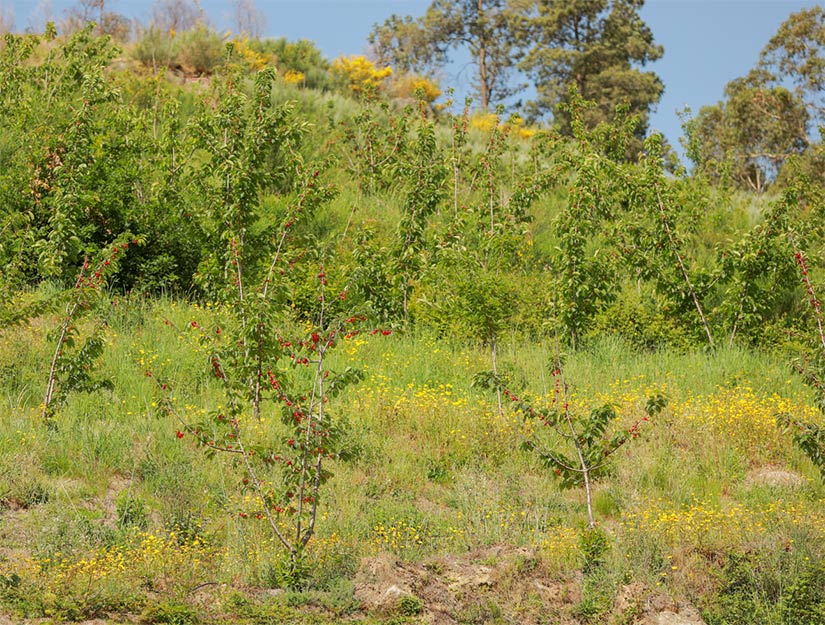
Revalorisation of the site
The building has been properly integrated into the landscaping of the site, while promoting inclusion and communication with the local community, biodiversity and providing habitat for native species. The following structures have been secured:
- The farm has upgraded the existing infrastructure;
- A bicycle parking area has been provided
- Parking capacity to ensure a place for each user who has to travel by vehicle;
- Pedestrian cycles as a privileged means of contact with nature, around and up to the farm;
Water resource utilisation
The building was strongly concerned with maximising the conservation of water, which is necessary to sustain the entire orchard, agricultural support and agro-tourism enterprise.
In addition to the rational use of water resources and its reuse, as described above, the following additional water management measures have been implemented:
- The roads, car park and walkways have been laid with permeable paving;
- Dual-flush toilets and low-flow taps and showers in all sanitary facilities.
Local Renewable Energy Resources:
Solar, Geothermal and Biological Waste
The proximity and relationship of the building to the agricultural activity polarises the development of technical solutions for the use of renewable resources available on site, thus enabling the implementation of more efficient energy systems:
- using air-condensing chiller heat pumps, but with the versatility of being able to be converted to use the geothermal resource in order to utilise the natural resource in the ground;
- The efficiency of the system has been optimised using seasonal thermal storage, making it possible to reduce the thermal power of the installed equipment, with peaks of greater thermal demand being met by using inertia.
- In addition, thermal recovery is also carried out between heat transfer cycles, when operating in cooling mode, condensation (heating) is utilised free of charge, and in reverse operation, too.
- the adoption of radiation systems (radiant floors) interconnected to the heat pump in order to carry out cooling in a way that utilises the natural resource of the ground;
- System for producing domestic hot water and heated water with renewable resources from biomass available on site, from forestry and agricultural waste, through the interconnection of water heat recovery units (fireplaces), duly interconnected with the centralised system;
- This equipment will be prioritised when this renewable resource is available, in addition to heat pumps;
- using solar thermal energy to produce domestic hot water (DHW);
- local electricity production systems that harness renewable solar energy using photovoltaic panels;
- use of outdoor lighting using renewable sources whenever possible;
Passive strategies
From the point of view of energy, the integration of solutions that exploit the potential of architecture has made it possible to design simpler and more energy-efficient air conditioning systems without neglecting the expected levels of thermal comfort and indoor air quality.
- Optimisation of the glazed area, in order to promote natural light inside the building's spaces, promoting greater penetration of sunlight in winter, contributing to its natural heating;
- Specific selection of glazing, taking into account the high level of radiation;
- High level of thermal insulation and correction of thermal bridges; Minimising the negative impact of the climate and making the building more sustainable;
- Promotion of natural ventilation through permanent openings in the façades in contact with the outside, thus ensuring cross ventilation;
- the proximity of water bodies and vegetation improves the quality and natural adiabatic cooling of the air;
- Thermal inertia: heavy masonry floor and roof slabs can absorb solar energy during the day and release the heat to internal surfaces at night.
The farm
Fruit trees have been planted on the various slopes of the Quinta, always taking into account the climatic characteristics of the area.
So in the upper part of the farm, chestnut and cherry trees were planted; in the lower part, at a much lower level, a mixed orchard was planted, with citrus, apple, pear and plum trees, among other fruit trees.
Soil fertilisation is based on the incorporation of organic compost made on the farm using the farm's undergrowth, cow or sheep manure from extensive production, sawdust and grape pomace.
Weeds are managed by cutting the vegetation between the rows and bundling it with scrub in the row. These practices save a lot of water and increase soil fertility. Care is taken to cut the vegetation as late as possible in spring, so that it acts as an ecological infrastructure that attracts numerous invertebrate and vertebrate helpers, which contribute greatly to limiting pests.
The agricultural practices implemented on the Quinta, as well as its location and diversity of habitats, allow for the presence of dozens of bird species, including the dauric swallow, Hirundo daurica; the chimney swallow, Hirundo rustica, the swallow of the eaves, Delichon urbica, the rock swallow, Ptyonoprogne rupestris, the royal and blue bonnets, Parus major e Parus caeruleus, the black starling, Sturnusunicolor, the thrasher; Turdus viscivorus; the common carthusian, Saxicola torquata, the green peto, Picus viridis; the black squawk, Corvus corone; the wren, Troglodytes troglodytes; the blackbird, Turdus merula; the red robin, Erithacus rubecula; the black-headed warbler, Sylvia melanocephala; a felosa do mato, Sylvia undata; the black fly swatter, Ficedula hipoleuca; the round-winged eagle, Buteo buteo.
The farm is visited by mammals such as wild boar, Sus scrofa and the badger, Meles meles.